OCS Research Note · Preprint · numerical correction to the nearest-neighbour jerk scale
An erratum to the jerk noise-floor constant in Prager et al. (2017) and Abbate et al. (2019)
Preprint v1.0 · 2026-10-03 · this HTML edition mirrors the LaTeX source (xi_erratum_note.tex); the PDF is canonical for citation
Pulsar spin-frequency second derivatives, jerks, probe cluster gravitational potentials and central masses against a stochastic floor of nearest-neighbour stellar encounters, whose characteristic amplitude is ȧ0 = (2πξ/3) G⟨m⟩σn, with n the stellar number density, σ the velocity dispersion, and ⟨m⟩ the mean stellar mass. Prager et al. (2017) quote the dimensionless constant ξ ≃ 3.04, and Abbate et al. (2019) adopt it. The double integral that defines ξ evaluates in closed form to √(2π) [1 + ln(2+√3)/(2√3)] = 3.4595806610: five evaluations of that one integral (a closed-form reduction, adaptive quadrature, symbolic evaluation, antiderivative differentiation, and high-precision quadrature) plus two independently coded Monte Carlo simulations of the underlying stellar field that never evaluate the integral, at 15.8σ and 14.6σ respectively, both reject 3.04; Section 3 states the common-mode caveat on the first five. Because ȧ0 is linear in ξ, the printed constant understates the jerk floor by 12.1 per cent, inflating the apparent significance of jerk-based central-mass inferences.
Keywords: pulsars: general · globular clusters: general · methods: analytical · methods: statistical
1. Introduction
Long-term timing of millisecond pulsars in globular clusters measures spin-frequency second derivatives, jerks, which probe the cluster gravitational potential and any intermediate-mass black hole it hosts (Prager et al. 2017; Abbate et al. 2019). Jerks from passing cluster stars follow the statistics of random backgrounds long studied as source confusion in radio astronomy (Condon 1974): nearest neighbours dominate, the sum has no finite variance, and its scale is set by a characteristic amplitude,
ȧ0 = (2πξ/3) G ⟨m⟩ σ n, (1)rather than by an rms. Here n is the stellar number density, σ the one-dimensional velocity dispersion, ⟨m⟩ the mean stellar mass, and ξ a dimensionless constant collecting all of the geometry (Prager et al. 2017). Both papers quote ξ ≃ 3.04.
While implementing this formalism for a study of NGC 5139 (ω Cen) now in preparation, I found that the quoted value disagrees with the integral that defines it, which has a closed-form evaluation (Section 2). Section 3 reports the verification, five evaluations of the integral plus two independently coded Monte Carlo simulations of the physical field; Section 4 traces how the error entered the published literature; Section 5 states the consequence for jerk-based inference.
2. The integral and its closed form
Prager et al. (2017) define ξ by the double integral of their arXiv v1 Equation B7,
ξ = ∫0∞ dx ∫−11 dμ [ 1 − exp( −(1+3μ2)/(2x2) ) ], (2)For fixed μ the bracket depends on x only through a/x2 with a ≡ 1+3μ2, and the inner integral evaluates to √(π/2) (1+3μ2)1/2. The remaining integral is elementary, ∫−11 (1+3μ2)1/2 dμ = 2 + asinh √3 / √3, and asinh √3 = ln(2+√3), so
ξ = √(2π) [ 1 + ln(2+√3)/(2√3) ] = 3.4595806610, (3)or, to fifty digits, 3.4595 8066 1046 2156 1909 2857 1405 6923 3043 7918 3879 5001 67. The closed form exceeds the printed value by 13.8 per cent.
3. Verification
I verified Equation (3) with five evaluations of Equation (2) itself, routes (i), (ii), (iv), (v), (vi) below, and two independently coded Monte Carlo simulations of the physical system, route (iii), that never evaluate the formula. Because routes (i), (ii), (iv), (v), and (vi) all evaluate or manipulate the same double integral, they share whatever algebraic or limiting error the integral itself might carry; only the two Monte Carlo passes are independent of Equation (2), and the rejection of 3.04 rests on those.
- (i) The closed form itself.
- (ii) Adaptive quadrature of Equation (2), agreeing with the closed form to 2.1×10⁻¹³ relative (7.3×10⁻¹³ absolute).
- (iii) Two Monte Carlo passes of the physical system, described next.
- (iv) End-to-end symbolic evaluation of both integrals, returning the inner result above and 2 + asinh √3 / √3 for the outer one.
- (v) Differentiation of the closed-form antiderivative used in the reduction, which simplifies identically to zero against the integrand.
- (vi) Arbitrary-precision quadrature of Equation (2) at 55 decimal digits (mpmath), substituting x = tan θ to remove the 1/x2 tail rather than truncating it, agreeing with the closed form to 3.1×10⁻³⁵ relative (
fH_verify_xi_mpmath_quad.py, accompanying the note; a 70-digit attempt did not converge in reasonable time). This route is a true numerical quadrature of the double integral, not arithmetic on the closed form.
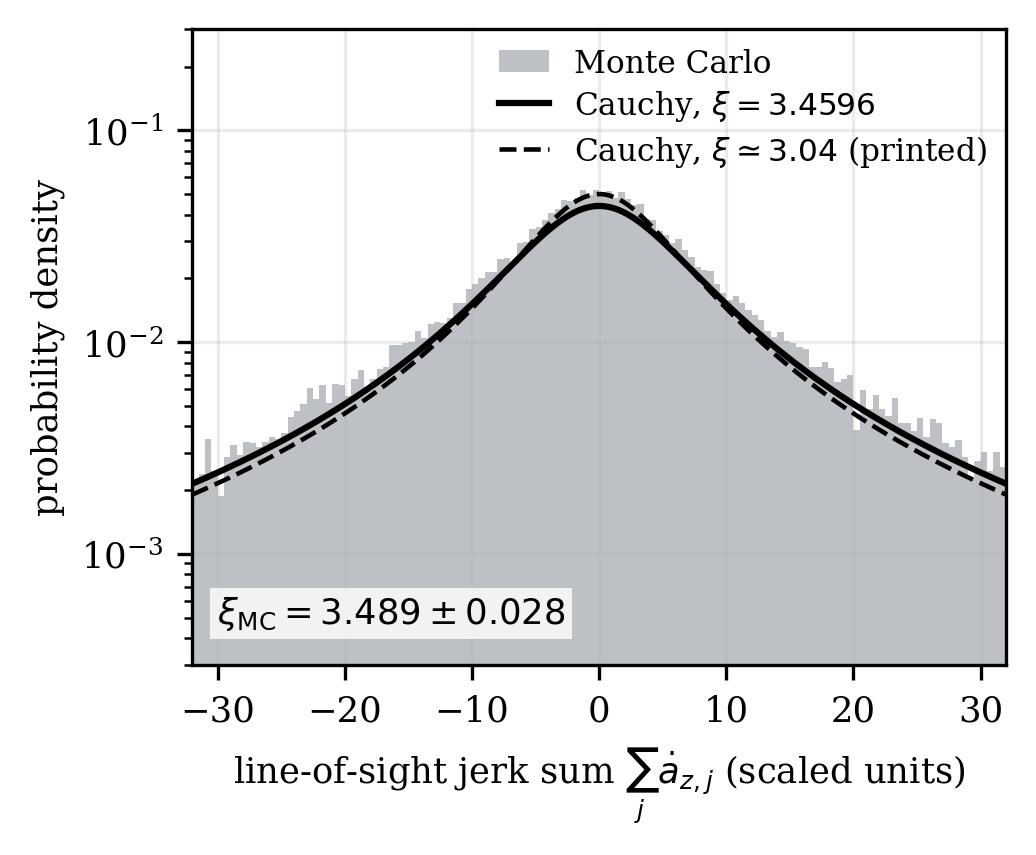
Route (iii), first pass, never evaluates the formula. Each of 4×10⁴ realizations draws Poisson(nV) stars uniformly in a sphere, assigns Maxwellian velocities, sums the line-of-sight single-star jerk of Prager et al.'s Equation B1 directly, and estimates the Cauchy scale from the interquartile range, equal to twice the scale for a Cauchy law and insensitive to the heavy tail that invalidates the sample mean. The result is ξMC = 3.4886 ± 0.0283: consistent with Equation (3) at 1.0σ and excluding 3.04 at 15.8σ (Figure 1). The same sample reproduces the published line-of-sight law in shape, with a Kolmogorov–Smirnov p = 0.26 against the Cauchy form, and in tail index, with a Hill estimate of 1.025 against the 1-stable value of 1.
A second, separately coded Monte Carlo (fH_verify_xi_second_mc.py, accompanying the note) built directly on the projected line-of-sight jerk expression with an independent seed, drew 4×10⁴ realizations, and estimated the Lorentzian scale from the interquartile range with a bootstrap standard error over 2000 resamples: ξMC,2 = 3.4403 ± 0.0275, agreeing with Equation (3) at −0.7σ and excluding 3.04 at 14.6σ. The two Monte Carlo passes sit on opposite sides of the closed form, at +1.0σ and −0.7σ, consistent with sampling scatter between independent implementations; a check of the interquartile-range Cauchy-scale estimator itself, 3000 synthetic draws of 4×10⁴ standard-Cauchy variates each, finds it unbiased to within 0.02 per cent, so the scatter is not an estimator artifact. The rejection of 3.04 rests on the two Monte Carlo passes; the 13.8 per cent correction rests on the closed form.
I also re-derived Equations B4–B10 through the characteristic function, reproducing every step including the angular factor s2(1+3μ2). The algebra is sound; the discrepancy is confined to the numerical evaluation of Equation (2). The verification scripts and the Monte Carlo drivers are prepared for a Zenodo deposit (deposit pending; the DOI will be added here once issued).
4. Provenance in the published sources
The derivation survives in full only in version 1 of the arXiv posting of Prager et al. (2017) (1612.04395v1), where Appendix B carries Equations B1–B10 and Equation B7 defines ξ as the double integral. In the v1 source the defining equation reads, for s ≥ 0,
C(s) = (2πGs/3) ∫ dm P(m) mσ ∫0∞ dx ∫−11 dμ (1 − e−(1+3μ2)/2x2) (4) ≡ (2πξ/3) G⟨m⟩σs,As printed, Equation (4) is dimensionally inconsistent with Equation (1): both sides carry no factor of the stellar number density n, so C(s) has dimensions of volume rather than being dimensionless. Reducing the right-hand side with x ≡ r3/(sGmσ), so that d3r = 2π(sGmσ/3) dx dμ, gives C(|s|) = (2π/3) n G⟨m⟩σ|s|ξ; the reduction also pulls σ outside ∫ dm P(m), which holds only if the velocity dispersion is assumed independent of stellar mass, an assumption Prager et al. leave implicit. I reproduce the source equation as printed and note the omission here rather than silently inserting n into a quotation.
where C(s) is the cumulant of the line-of-sight jerk's characteristic function at conjugate variable s ≥ 0 (the full symmetric-Cauchy cumulant is linear in |s|, not s), followed, in the same paragraph, by the sentence: "where ⟨m⟩ = ∫ dm mP(m) and ξ ≃ 3.04 is the numerical value of the integral." Integral and number share a sentence, so no alternative convention can reconcile them: the text offers 3.04 as the value of this integral, and the integral equals 3.4596.
The published article (ApJ, 845, 148) truncates Appendix B after Equation B3 and so removes the definition of ξ, while main-text Equation 8 retains ξ ≃ 3.04 and points to Appendix B for its origin; a reader checking the constant against the journal version alone cannot reproduce it from what is printed. A citation screen of the works citing Prager et al. (2017) or Abbate et al. (2019) (OpenAlex, 2026 October 3; 102 works; per-title dispositions accompany the verification package) finds no published correction to the constant, and exactly two works adopt the printed value in an inference: Equation 6 of Abbate et al. (2019), and Corongiu et al. (2024), who print "where ξ ≃ 3.04 is a numerical constant" in the characteristic-jerk relation and use it in a published core-mass inference for NGC 6752.
5. Consequence for jerk-based inference
By Equation (1) the floor is linear in ξ, so the printed constant understates the stochastic jerk floor by 12.1 per cent. The direction of the error is the unfavourable one for inference: a floor assumed too low inflates the apparent significance of any jerk-based central-mass constraint, including the Bayes factors that Abbate et al. (2019) tabulate, which inherit the constant. I have not recomputed those values; a 12 per cent rescaling of the neighbour term is unlikely to move qualitative conclusions, but quantitative claims near threshold deserve re-examination by the groups concerned. Any analysis using the formalism should state which value of ξ it adopts.
References
- Abbate, F., Spera, M., & Colpi, M. 2019, Intermediate mass black holes in globular clusters: effects on jerks and jounces of millisecond pulsars, Monthly Notices of the Royal Astronomical Society, 487:769. 10.1093/mnras/stz1330. arXiv:1905.05209
- Condon, J. J. 1974, The Astrophysical Journal, 188:279.
- Corongiu, A., Ridolfi, A., Abbate, F., et al. 2024, Timing of Millisecond Pulsars in NGC 6752. III. On the Presence of Nonluminous Matter in the Cluster's Core, The Astrophysical Journal, 972:198. 10.3847/1538-4357/ad5e74. arXiv:2407.03271
- Prager, B. J., Ransom, S. M., Freire, P. C. C., Hessels, J. W. T., Stairs, I. H., Arras, P., & Cadelano, M. 2017, Using Long-term Millisecond Pulsar Timing to Obtain Physical Characteristics of the Bulge Globular Cluster Terzan 5, The Astrophysical Journal, 845:148. arXiv:1612.04395